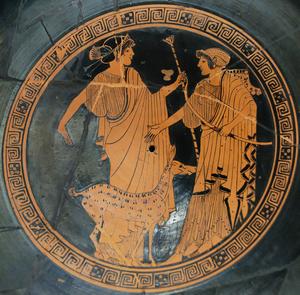
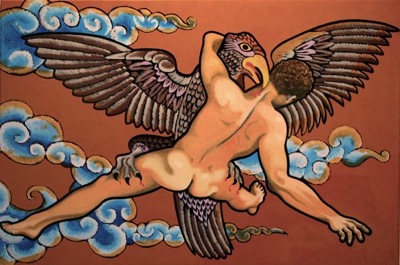
Been thinking of starting a Facebook group linked to this site, and I thought this might be a good logo

Been thinking of starting a Facebook group linked to this site, and I thought this might be a good logo
I awake, early and cold
My skin objecting as I move to the freezing air.
I walk out into the air
The sky is still dark and the moon still shines brightly
I turn to face East
And there the sky is starting to change colors
I close my eyes to venter myself
And from my lips a prayer is released to the aether
I sing you a song, lord of the rising sun
As my soul is made purer by this act of mortal devotion
I say a thank you, my naked body shivers
And as I speak your holy name I am made warm by your presence
Helios, I say, thank you and welcome
And into my life you come, your warmth, your light, your watchful eye.
I kneel in the Earth, it is still moist from rain
And rise and turn to return to the shelter of home
I shiver again and am reminded
That fragile are we who adore you and not grateful enough for your love.
Since I am pondering the parts of Artemis, and I am trying to come to terms with what they all mean, I want to touch on a different aspect of my personal theology that may prove useful.
I call them detached or autonomous aspects. These are aspects of deities that take on a life of their own. Aspects of deities which, in the mythic cycle and even in popular belief, become independent entities. These aspects of deities can actually be aspects of many different deities which are seen by the people as the same mythic figure. In practice, there is a fine line between acknowledging Gods and their aspects and angeloi, which I see as small aspects or pieces of a deity which behave like independent beings.
What do I mean by this? I will use a couple of examples...
The Erotes
The Erotes are like little angelic beings that in myth act at the behest of Aphrodite to pierce the hearts of people with their arrows of emotion. In essence, they are little aspects of her, the little bits of her that inspire the varying heart felt emotions of our lives. Things like infatuation, love, jealousy, desire, lust. Are they literal beings? Probably not, but through poetry we have made them real. We recognize in ourselves a little bit of the Goddess of Love and Emotion, and so we picture each of our hearts, our emotional centers, as being manipulated by these little critters. But they are all really her.
Medusa
Medusa is a different kind of figure. A vengeful spirit, some might even say malevolent, yet also protective. The myth of Medusa is based in the larger epic cycle of the Greeks as the heroes of their legends sought to go forth and conquer the world around them, which included conquering their own fears, fears like Medusa, who represented to them the bitter outrage and fearsome vengeance of the Gods.
Unlike the Erotes, however, Medusa is not the aspect of a single deity, but rather, an aspect of many as well as an aspect of feminine rage, a rage that must have festered in the hearts of many women in ancient times when women were so ill treated by men. One imagines that in today's world, that same avenging spirit remains very much alive. The essence of what Medusa represents is still very much active in the world today, a world in which women are still often little more than slaves under the thumb of barbaric patriarchal religions like Islam, and no, I won't apologize for that characterization, as I won't apologize for the same characterization of Christian churches which still insist on calling woman the subservient sex.
But the power of what Medusa represents is also something different. The vengeance and protection of the Gods themselves, especially the Goddesses. The myth of Medusa, or rather, of the Gorgons, is rooted in very ancient times, and that of Medusa herself, a mortal woman turned into a Gorgon, is rooted in the mythology of Athena, a goddess known for her rather terrible temper when it comes to propriety. But that myth is also rooted in the idea that the rape of women calls on a deep, dark, power of vengeance, a power that can turn men to stone. That is, paralyze them.
When Medusa is raped in the temple of Athena by none other than Poseidon, Athena, in her rage, transforms her into a Gorgon. To the Classical Greeks this seemed a punishment, but perhaps to earlier people it was understood as something more. Perhaps they understood that this tale spoke of the ultimate violation of a nation, the nation of Athena, being violated by another and the nation itself rising up with power beyond anything it once had and lashing out, protecting itself in the future. See, Athena did not simply transform the poor maiden into a monster, she transformed her into a creature that could protect itself against any attack. That it is Athena herself who in the mythic tale of Perseus helps him kill her, though not her power, indicates that the Goddess has retaken her power, she has made her nation strong. That in her nation women were often little more than property is one of the great dichotomies of the ancients, but myth tells us of happenings, not necessarily of the moral values of those happenings.
Ancient people placed an effigy or mask of Medusa at their home entrances, this symbolized protection, and in this we see a transformation of Medusa, from nearly demonic creature to protective spirit, and so again it seem to represent the power of a divine being.
Both of these types of beings, the angelic, and the demonic (not demonic in the Christian sense) represent aspects of greater powers, but in the case of Gorgons, Furies, Muses, Graces, etc., these can represent more than one being. The Muses can represent inspiration, but the inspiration of Apollo, or Zeus, or Hera, or Athena. The Furies can represent the anger of Gaea, or the vengeance of Persephone. The Gorgons also represent many, and in so doing so, are as agents of greater powers.
They are such because we human beings tend to understand them as such, because in them we are able to separate the aspects of the great Gods that seem undignified or dark and place them somewhere more fierce or terrifying. It would seem unbefitting of the Holy Mother of all things to lash out at us with destruction, so her power made manifest in the world around us can seem like that of Furies, as can the power of any Goddess.
I find myself at odds with Artemis. I think, perhaps, because it is Winter, I am not finding myself in the proper mood and state of mind to explore the aspects of this goddess that is a force of nature. There are still woods and wills and deer in Winter, of course, but it becomes harder to set out and try to put myself in their midst at this time of year.
It is not, of course, necessary to do this, this goddess has so many facets that I could explore them and leave the others to the coming Spring, but I find that I prefer to be dragged, kicking and screaming into whatever the Gods make available than to try to force it.
So far, however, I have come across an aspect of this goddess that forces us to look into our faith and come to terms with what it means to believe in something so surely that you know it to be truth, even if others do not agree. Artemis, I think, forces us to look at this because she, perhaps more than any other goddess in the Hellenic pantheon, is mired in contradiction. Artemis, the virgin, is also the huntress. Artemis, the protector of children can also be the killer of women. Artemis, the mother, can also kill niobe's children. Artemis, the healthy runner in the woods, can also be Artemis the plague.
This isn't uncommon in Pagan religious theology and iconography. Unlike the Christians (and the other Abrahamic faiths) the Greeks did not try to force their Gods to be either all good or all bad. They understood that these beings, these divine forces of nature and the universe, acted from a place far more vast than our own, and as such, some of the things they did seemed bad from our perspective.
But for some deities, this can come off as too much. It is not that I question her power or her good will or anything like that, but that I am having trouble putting them into a series of parts in my mind that make a whole. For this, I will have to take some time this Spring and try to connect to her more natural aspects, her more pervasive energies.
Thinking about the arrows of the Gods, symbolic as they are of divine interaction with the mortal world, I am brought once more to a concept which must be central to any consideration of the Gods, the concepts of life.
I remember reading, a long time ago now in another city in another state in what seems a different life in Walter Burkert's book on Dionysos that the Greeks had more than one word meaning life. These were not simply synonyms, however, but conceptually different words that when used expressed different things about life.
The first word relevant to this discussion is Bios, from which we get the word stem bio as in biology. Bios is mortal life, biological life, life based in the animal and vegetable world. We know today that this life is based on things like cells, DNA, RNA, and is organic in nature, meaning based on the organic element carbon. Biological life is strictly mortal. It begins, reproduces, and eventually ends. In doing so, it also mutates and changes, improving and evolving as it interacts with the environment around it, an environment which is often very hostile to it. Biological life adapts, and that is its greatest strength.
Biological life is linked, and is reliant on, its environment. It exists as part of the very natural rules, physical laws, that make the universe itself possible because it arises from them. Terrestrial life is linked directly to the elements and conditions that the Earth provides, and it adapts to suit it, being forced to do so as it survives. Life on Earth is of Earth. It contains within it the very elements that make up the Earth, from carbon to metals and complex molecules created by geological processes long ago. The Earth gave birth to us, and we are part and parcel of it just as we are part of our mortal parents.
The planet Earth, however, is also mortal. It came into being, it exists and continues to change and evolve, and one day it will die, the internal processes that keep it going slowing down and stopping, like the heart of an animal stops. Perhaps it will be destroyed, the sun growing and engulfing it as it progresses into a new stage in its "life", because the sun too is mortal. One day it will grow and then shrink, leaving behind a simple white dwarf, and eventually even that will dim and die away, forgotten in the broad arm of the galaxy. And the galaxy too is mortal. Mother to the sun and earth, it too will eventually be torn apart by a collision with a sister galaxy, perhaps merging into one, or being destroyed as two new galaxies form around the cores that continue to grow and swallow up matter, the enormous super massive black holes.
And yes, they too are mortal, slowly leaking information in minute particles, and one day when the stars have burned out and the former galaxies are nothing but enormous black holes drifting in the vastness of space/time, they will slowly dissipate and die, and then the universe, also mortal, will settle and die a cold lonely death.
We share in that universal nature, the one thing all things in the universe have in common, their mortality.
Biological life, then, is an organic manifestation, on a small scale, of the reality of the universe, and we, who have adapted and changed to suit the environment it throws at us have grown into thinking rational creatures that can ponder this very reality.
But Biological life, the Bios, is dependent on the universe, which while mortal seems to us eternal in the same way that the universe relies on far greater things that are not actually mortal, but are truly eternal, truly immortal. We call them Gods (or God, if you have been brainwashed into thinking there is only one) and they exist as a form of life called Zoë.
Although we get the stem Zo, as in Zoo and Zoological, from Zoë, the term in a religious sense indicates life as a constant, ever present, eternal thing. The Gods are categorized not as Bios, but as Zoë, because they do not take part in the same processes of life that Bios does. We call this form of life divine, and we call the individuals Gods, which we honor, worship, or otherwise acknowledge as having an important role not only in our lives but in the very life of the universe itself.
Unlike Bios, which is self contained and individual, divine life is more diffuse, more spread out into the very universe itself, and it is not possible to think of them, the Gods, as being even limited in terms of interaction, for they overlap, merge, cross each other, combine and separate, and are, for all intents and purposes present in all things, living or not, organic or not, in various combinations.
Zoë is part of the eternal realm. The Eleventh dimension, that dimension of space which is the container of all things. It is timeless (eternal) and spaceless (infinite) and we call this realm by many names. In our religion, Olympus, Elysium, Tartarus, and Hades are names we give to different aspects of this realm. The life of this realm is, by its nature, eternal (having no beginning and no end) and infinite (having no spatial limitation) and are, here, privy to all of existence.
Unlike Bios, Zoë is vast. An individual God is infinite in form and has no need to account for time. One would even wager that the concept of time itself is likely a difficult one for such beings. One might even ask if the universe itself, molded and guided as it is by the Gods, is not a kind of experiment on their part to understand these concepts. But I tend to think they are beyond such games and could find easier ways to understand such things.
Unlike Bios, Zoë has no need to reproduce, but they do create. They have no death, but they do change. They have no need of sustenance, yet are fed by our adulation. The universe is as a laboratory of sorts, I admit, but it is also something else. Their work of art. Their child. Their most cherished creation, for it is given by them a portion of their own being, which to us seem not like people, but powerful forces, forces that act in accordance with their natures but always in balance with the other forces of nature.
That Bios seeks to understand them by clothing in flesh like its own is not so mysterious, what remains a true mystery is if, perhaps, there is a small spark of them in each of us, what happens to them when those small sparks rejoin them, become part of the whole universe again. Does my life bless that spark with something good, something wonderful, or will my ultimate gift to the Gods be my misery, hatred, and unwillingness to change.
I think I shall endeavor to bless that spark with a little joy, a little pleasure, and a little love.
The question of faith brings up a question. How much of myth, legend, and poetic storytelling should be taken literally, how much as fancy, and how much of it should we assume is meant to teach us something about ourselves, about the Gods, and about the paths of life?
They are questions meant for individual consideration, of course, as each of us has to decide this for ourselves, but I do think it important that we who have walked this path longer reach out with our words so that those who come along behind us are not lead astray by overly zealous or overly literal interpretations of ancient texts.
The title of this post is The Arrows of the Twins, and I titled it that because those arrows, metaphorical arrows I should say, are part of the issue at hand. In myth, several deities are said to shoot arrows at mortals, an act of aggression at best, yet these arrows are almost always allegories for things such as disease, health, love, hate, jealousy, etc. When Eros fires his arrows into the hearts of men it is an allegory for the lust that we men are prone to. When the Apollo fires poisonous arrows, they are allegories for disease, and when Artemis fires her arrows at a birthing mother, it is an allegory for that most tragic of deaths.
The ancients understood, as we sometimes forget, that the Gods are not so much super-people as they are unimaginable forces of nature. Forces beyond our power to fully understand, yet which we must try to understand if we are to grow and evolve as sapient creatures. When we speak to newcomers to our path, our religion, we must try to be clear about this because the mythology studies in schools are useless in educating them about more than the idea that the Greeks were a silly people who believed in a man riding a chariot in the sky.
We must make it clear to them all that our myths are heavily allegorical and that the nature of the Gods is essentially unknowable, even if we can come very close to understanding some of their aspects. That with the good comes the bad, because the Gods act not to satisfy our whims but to assure the balances that keep the universe running.
The Gods are not evil, nor are they good, those are concepts brought to us by the friendly neighborhood Christians who would like nothing better than to convince you that you are an impure sinner that needs them to save you. We must reassure them that the arrows of the Gods are not meant to hurt us or save us, but to assure of us the full breadth of life, which sometimes includes suffering and sometimes joys beyond imagining. We must be willing to question them as well, because the arrows of jealousy can be balanced by the whispers of wise counsel in our ears and the recklessness of love can be balanced by the knowledge that the arrows of Apollo can sicken and weaken you.
We do not have a moral guide in our religion. Even if we did, it would be woefully outdated and old fashioned, so we must remind our young charges that the arrows of the gods can strike and that the best defense is to recognize them and act in accordance with the principals of wisdom, balance, and caring. And so, Apollo and Artemis can strike us down only that we may get back up, stronger and better than ever, but we, not they, make the decision if that happens.
Since I started on the Artemis point of the star, some things have been on the periphery of my consciousness, things that seem to be pointed out by the world around me. I think most of us know what it's like to have something brought to mind in a meditation or a prayer and then have the world around you constantly reminding you of it.
As part of my work, which is actually work I am trying to do on myself, not necessarily for the gods, I find the idea of faith coming up over and over again. I am especially troubled but the confusion we Americans seem to have about what faith means and how it relates to belief.
What do I mean by that?
In all manner of discourse I now hear people saying "I believe" or "I don't believe" with regard to things they see in the real world. This is a kind of negation of reality, especially with regard to things people like to speak about but which they actually know nothing, or little, about. It is this same kind of discourse which has brought to the fore things like the debate between creationism and evolution.
On both sides, people will say that they believe their way is correct, yet know little by way of the other side of the argument. This proves a problem in any rational discourse, because people will simply dig in to what they "believe" without ever giving the other person a chance to make a logical argument. What makes it worse, however, is that as a result, even when something is proven more likely, or possibly proven true by science, those who "believe" may simply decide that to hear such proof is blasphemy and therefore refuse to hear it.
This is not faith. This is simply stubborn refusal of reality.
Faith is a form of belief, but it is not, should not be, a stubborn refusal to accept facts. To deny the earth is a globe, for example, because an ancient tome says it is flat would be to expose oneself as an idiot.
Not, that is not faith.
Faith is trust. Trust that the Gods, in whatever form you may worship them, have a hand in the workings of the universe, and that regardless of how science reveals their work to play out (how they accomplish these works) you can still hold on to the reality of their existence. And faith can stand up to the scientific disproving of ancient myth, because myth, like science, has always been a way for humanity to explain the world around them.
You don't throw the baby out with the bathwater, and you don't throw the Gods out with quantum physics.
Why it is Artemis that has set me to pondering this I don't know, but it is perhaps as a way to prepare me for when I am ready to move forward, because when I do I will have to face my definitions of faith and belief.
Day Seven of Heliogenna begins the third segment of the festival, with dedications to Hyperion, the Titan father of Helios, Eos, and Selene. To Eros, the primordial God of attractions, love, and especially male eroiticism. And to Hekate, walker of the secret pathways between the dark and the light.
The Sunrise segment is celebratory rather than commemorative in nature, looking forward rather than back.
To Hyperion, Eros, and Hekate
Along the sacred way, I come upon a crossroads
A fork in the dirt path.
There stands a herm, and at its base offerings
Offerings of sweets
Offerings of bread
Offerings of milk and honey poured into the earth
Do I walk left?
To the darker realm of memory?
Do I walk right?
To the lighter path of the future?
To the left I see echoes of times gone by
Where Hyperion shone upon the land
And Eros held sway
It is a time long ago, before the war of heaven
And the fall of the mighty Titans
I hear songs too
Praising the shining lord who saw all things
And the tender embraces of boys in bushes
To the right I see change ever moving
Where Eros holds sway with Aphrodite
And the son of Hyperion shines bright in the heavens
It is a time not too far from now
Where Olympian Gods rule heaven and earth
To Hyperion, once lord of the sun
I leave golden mead
Tasting of honey and colored like his radiant hair
To Eros, who pulls us together
I leave rosy wine
Tasting of grapes and pink like the blush of a lover
And to Hekate, who walks the unknown paths
I leave the picture of a love lost
With the my hopes and dreams for a future
Off to the right I walk
With the memories of Hyperion behind me
The joy that is Eros ever with me
And torch bearing Hekate lighting the way ahead.
Day Six is for Helios and Dionysos, this time as the reborn Gods. Rejoice for the sun is reborn, and Lord Dionysos has come to Delphi. Drink and be merry and offer up burnt offerings to the holy sun.
This is also a day to make offerings to Persephone, the underworld queen who is also the goddess of hope in resurrection. Call her that she may be reminded that her time to be among the living is not so far away now.
Helios
Bright
Helios
Holy
Helios
The blazing sun
Helios who watches us one and all
March to your immortal horses
Helios who lights the firmament
Mount your golden chariot
Helios who sees all
Ride high into the sky
Helios
Bright
Helios
Holy
Helios
The blazing sun
______________

Dionysos
Dark
Dionysos
Mad
Dionysos
The living vine
Dionysos who intoxicates us
Free us of our inhibitions
Dionysos who maddens us
Show us glory in truth
Dionysos who sits silently enthroned
Let us love with wild abandon
Dionysos
Dark
Dionysos
Mad
Dionysos
The living vine
Heliogenna's essential point is to celebrate the Solstice. This is a common point of celebration among pagan religions, most religions, in fact, but I like to think of the Solstice as a dark moment, a silent moment. I like to think of nature holding its breath for a moment and releasing it.
Because this is a kind of "Sol Invictus" celebration, I like to think that that moment when the Sun is still, having reached it's lowest point, it's shortest time of brilliance, as a moment that should be commemorated with silence, but I do not like to think that nothing should happen this day. Rather, I like to think of it as a day to simply be silent toward the Gods, be they the Olympians or the Chthonoi.
Day Four marks the beginning of the segment called Night, and in night the mood shifts from thanks to rememberance and commemoration of the dead. The Fourth Day is in honor of Helios and Dionysos (Apollo too if you choose to include elements of the Dionysian lordship of Delphi during the Winter) and this day includes an offering, which you can make as you see fit, to the Lord of the Underworld. A friend of mine suggested, if you live in warm climes, a luau with a pig roasted underground, that would be awesome.
I should note that the day of the Solstice itself, the fifth day of the festival, is a silent one. No offerings, no lit candles, no prayers, just a day for man to be as if dead to the Gods.
To Helios and Dionysos
Your light grows dim
The days ever shorter
And soon you will go down into the underworld
The Earth shakes
Maidens twitch nervously
And soon, o mad god, you will come
Down below
Your light is smothered
Man faces the shortest day of all
Revelry is yours
You who have come
You who rule over the Winter at Delphi
We await you
You who will rise anew
You who will be resplendent and envigoured
Come, dark Dionysos
Come and lead the procession
Toward the flowering of Springtime
Come, bright Helios
Come and light the way
The way toward the coming Springtime
In darkness, you were born, who set to work in earnest to create the universe. To you I whisper my thanks, for without you we would be nothing.
To you, O Dark Nyx, who spread her wings wide
Who made way for all that would come
Who set the empty universe into its first order
I give thanks and offer my prayers
To you, O Erebus, who remains forever unseen
Who lives in darkness eternal
And brought to all that begins an end
I give thanks and offer my prayers
To you, O Broad Bosomed Ge, who is the foundation of all things
Who made of disparate parts a whole
And made all life possible
I give thanks and offer my prayers
To you, O Dark Hearted Ouranos, who envelopes the Earth
Who shines with dull star light
And made the broad sky
I give thanks and my prayers
It is through you that all came into being
It is by you that all things were set in motion
It is to you we owe our lives.
I light this flame in your honor, blessed Hestia
In your name do I call to them
In your name do I pray
To you, blessed Zeus, I say thank you
For the torrents of rain
For the crazed power of manhood
And the restraint of a king
I thank you, o bright and highest
I thank you, o lord of the heavenes
To you, blessed Hera, I say thank you
For the tug of heart strings
For the loyalty of woman
And the nobility of a queen
I thank you, o lady divine
I thank you, o queen of heaven
To you, blessed Poseidon, I say thank you
For the beauty of the sea
For the shaking of my expectations
And the strength of an uncle
I thank you, o fluid one
I thank you, o lord of the mighty oceans
To you, blessed Athena, I say thank you
For the certitude of knowledge
For the force that is wisdom
And the safety of your shield
I thank you, o grey one
I thank you, o lady of battles
To you, blessed Apollo, I say thank you
For the sweetness of enlightenment
For guiding me when I am lost
And the skills of healers
I thank you, o celestial lord
I thank you, o lord of prophecy
To you, blessed Artemis, I say thank you
For the purity of thought
For your clarity of purpose
And the innocent heart of the virgin
I thank you, o wild one
I thank you, o lady of the mountains
To you, blessed Ares, I say thank you
For the ferocity of your will
For your blessed protection
And your heroic spirit
I thank you, o fierce one
I thank you, o god of soldiers
To you, blessed Aphrodite, I say thank you
For the body's sensual delights
For your gentle hand and firm commands
And the feelings you inspire
I thank you, o terrible one
I thank you, o lady of passions
To you, blessed Hephaestus, I say thank you
For the molding of beauty from ugliness
For your inspiration
And the hard work that makes it real
I thank you, o tired one
I thank you, o lord of the mastered fires
To you, blessed Demeter, I say thank you
For the fruits of nature's bounty
For the grain that makes our daily bread
And the knowledge that makes it possible
I thank you, o golden haired one
I thank you, lady of the plowed fields
To you, blessed Hermes, I say thank you
For the exuberance of youthful men
For the desire to see new things
And the boundaries that make us human
I thank you, o swift footed one
I thank you, o lord of the well worn paths
To you, blessed Hestia, I say thank you
For your steadfast protection
For the spirit of home
And the unending fires that warm us
I thank you, o pure one
I thank you, o lady of the home fires
The sun sets
The moon rises
The sky is rosy, golden, and blue
The eternal lords and ladies of light and dark settle in
See us, O Helios
Guard us and watch over us
Welcome us, O Eos
Offer us shelter and warmth
Shine upon us, O Selene
Guide us through the dark night
The sun sets
The moon rises
The sky grows darker and cooler
The eternal lords and ladies of heaven and earth settle in
Look upon us, O Helios
Watch our toil, our love, our fear
Host us, O Eos
And bid us enter into your embrace
Light the way, O Selene
That we may not fear the night
The sun sets
The moon rises
The sky has grown black
The lords and ladies of the celestial realms settle in
I was looking online today, and one of the search terms I used was "The Goddess Artemis". As you can imagine, that search term resulted in innumerable pagan, neo-pagan, historical, archaeological, and even christian sites. Among these were sites that fit into the magical/neo-pagan vein that bugged me. Not because they were magical or neo-pagan, the ancient Greeks practiced forms of magic and had many superstitious beliefs (not saying all belief in magic is superstitious, by the way) that included the Gods and their many "powers". What bugged me was the way some of these site present misinformation, fantasy, and myth as fact backed by historians and archaeologists.
One such site claimed that the cities of the Eastern part of the ancient Greek world, cities like Ephesus, for example, were founded by Amazons, and that it was the Amazons who founded the cult of the Great Goddess of Ephesus. Claiming that historians agree this is the case.
Let's make this clear, while it is possible that what the Greeks called the Amazons were a real culture that was subjugated by the Greeks at some point, and that it being in the Eastern Aegean makes some sense, there is no historian, other than one wearing a tin foil hat, who would make a claim that with absolute certitude they existed and had founded Ephesus. Claiming this is at best a lie, at worst the sign of a truly stupid historian or archaeologist who is simply seeing what he or she wants to see in the evidence of that area.
I am not a believer in presenting myth as reality. I see it as a separate thing, something that is representative, sometimes of forgotten history, but never to be taken literally. Were there Amazons? I don't know, but the amazon myth is not one to be taken literal. Was there a Thesus? I don't know, he could represent a great king of ancient Athens, but one should not take his existence for granted as anything other than a myth.
So, what do I see as myth, and what value do I place in it?
Myths are stories which, told over centuries, gain and lose much detail. Some myths are about explaining the Gods and how the people of a certain area see them. Some myths are the stories of great actions, heroic deeds, and great sacrifices made by real people which gain in them fictional elements, or elements that explain the way the people see their actions as being in accord with the will of the Gods. Some myths are pure fiction, created to explain the world or even to frighten children into behaving properly. Which ones are which is not something we can know with any certainty, except as our own speculations.
I see in myth a variety of uses, and I hold them to different levels of esteem and sacredness depending on what they seem to accomplish. The myths present in larger stories, such as Iliad, Odyssey, or in philosophical works, present to us myth as fiction, or as education. These, especially, become more "sacred" to me than do simple myths, but they all are important to the way we perceive the Gods and the people of the ancient world.
To me, Myth is useful, and I value it as these:
In so far as myths accomplish any of these, or any combination of these, I find value in myth. Where I find myth sacred, however, is in ritual that illuminates the divine in the context of prayer, ritual, or meditation.
Presenting myth as history, however, is a no no. Myth can lead us to history, by asking the question, were there Amazons, we can be lead to explore the history of the Eastern Aegean, but taking the myth itself as proof only makes me question your credibility, and in some cases, your intelligence.
Lift us up, blessed Zeus
To the heights of heaven
Where all things are visible
Where all things are clear
Lift us up, blessed Zeus
From our pain and sorrow
Where we so often wallow
Where we too often hide
Lift us up, blessed Zeus
To the starry firmament
Where dark mysteries live
Where eternity stretches her wings
Lift us up, blessed Zeus
From the depths of despair
Where we yearn to give up
Where we want to give in
Lift us up, blessed Zeus
To the bright blue sky
Where clouds dance and change form
Where the pretty birds fly
Lift us up, blessed Zeus
From under the heel of oppression
Where one man humbles another
Where freedom is but a dream
Lift us up, blessed Zeus
To the greatness that is joy
Where there is no pain
Where all but the purity of the soul is forgotten
Far in the distance
Where the Earth meets the Sky
There is a palace of gold
And broad gates lead to the stable
There immortal steeds rest
Restless and enflamed
Awaiting their master
Whom they will guide across the bright blue sky
It is the palace of the Sun
Blessed Helios of the glowing crown
Son of Hyperion
There by the gates
Where the world of the living meets the world of the dead
There stands a beautiful girl
Dressed in rosy robes of gossamer
She opens the golden gates
And walks through
The color of her robes
And the tint of her cheeks tinging the sky itself in red.
It is the blessed morning
The time of Eos of the rosy cheeks
Daughter of Hyperion
The cock calls to him
The bull moves in the fields
Man sets upon a day of toil
Watched as always by the children of Titans
Lighting their way.
Among the many aspects of Artemis that are seemingly contradictory, is that of the far shooter who brings death. Like Apollo, Artemis is a dichotomy in that like him, she is a protector of life, a healer, especially when children and women in childbirth are concerned, yet she also deals death from her quiver. When a woman died at childbirth, it could be said that she was struck down by Artemis.
Of course, the dangers of childbirth are well known. Even with all our technology, all of our medical advancement today, women often die in childbirth, and as the goddess who is often invoked as part of that ordeal, it seems to make sense that she would be blamed for the deaths that occur during it as well.
Often, we who worship at the altars of the ancient gods will have trouble using negative terminology when referring to the actions of the Gods. The immense Abrahamic influence on our society means that the same kind of fear or feigned respect that they pay to their deity is often manifest in our attitudes toward the gods. The ancient people, however, had a healthier and more realistic appraisal of the gods. They understood that the gods did not simply give us all the good things in life, but that many of the bad things came from them as well. Their reasoning mysterious, for sure, but whatever made such things necessary in the greater scheme of things was accepted and they understood that the gods acted for reasons we did not always understand, and as a result, it was ok to sometimes feel anger at them for the things they seemed to throw their way.
Like the ancients, I do not have an "everything is rosy" attitude toward the gods. But I have to admit, sometimes I wonder if Artemis is not a bit of a cold hearted bitch. Oh, don't get me wrong, I have a great deal of respect for her, and part of me understands that as a nature goddess, she will sometimes seem cruel from my perspective. After all, is not the lion pride tearing apart the still living deer cruel? But part of me also has to have respect for the attitude. Nature is as nature does, and Artemis, at least in this aspect of divinity of the natural processes of life, must by her nature seem cruel to us.
Artemis' myths make no bones about it. Her demand that Agammemnon sacrifice his only daughter, the tearing apart of the hunter who sees her naked form, the destruction of the children of Niobe, all point to some of the darker aspects of the divine, some of the aspects which we don't like because they remind us of our mortality. They remind us of our place in the grand scheme of things. A place we are sometimes too arrogant to accept without a fight.
Time has no meaning
It is but the flow of a stream
Subtle and slight
To they who are eternal
To they who are divine
Space has no meaning
It is but a fallow field
Flat and full of potential
To they who are undying
To they who are holy
Fear has no meaning
It is but a slight breeze
Felt but not perturbing
To they who are ephemeral
To they who are sublime
Death has no meaning
It is but an open door
Empty and small
To they who are infinite
To they who are sacred
In the Eastern lands, where Greeks lived side by side with other peoples of many different cultural backgrounds, the goddess Artemis took on a different aspect and demeanor than that of the mainland Greeks. This is not, of course, odd. The Gods seem to appear to people the way they are needed, so even though most of us look at the Gods with rather a limited view of their domains of influence, I think the Gods themselves share no such idea of limitation.
At Ephesus, the goddess Artemis was worshipped as a much grander form, a much grander aspect than she was in many other places, and this leads me to ask myself a question. If the Gods can each be different things to different people, then why do we need to worship so many of them? Why can't we just pick one, say Artemis, and call to her for her aid in all things?
The answer seems to be there is no reason you cannot, but that the aspects of nature, culture, etc., that a particular deity was associated with were likely those aspects of life that that particular deity took an interest in. If a deity is a living thing, a creature not of our own making, but a truly living and eternal being capable of independent thought and will, then they must also have interests in the mortal world that we try to fathom but can only ever come partially to grips with.
This is why Aphrodite is seen as "Goddess of Love, Lust, Beauty" etc., because as the ancients experienced her, they saw that it was there that she seemed to express her power. But what if to another group of Greeks, or another culture, she expressed her power in other ways?

In Ephesus we see a clear example of this, but also an example of a potential problem in our attempting to make sense of the Pantheon of the Greeks.
For me, the problem is not in my personal faith. I do not believe in limiting the Gods, only in limiting my own interaction with them. What I mean by that is that I can ask Athena for healing, and I have no problem believing she could aid me in that, but that I turn to Apollo because that is what he is known for. I can ask Artemis to help me find love or a sexual partner, but I know that Aphrodite is best known for that, and therefore it is she I turn to.
Artemis' Ephesian aspect, however, proves a little problematic for me. The Ephesian Artemis seems much more of a "Mother" figure than the Artemis of the mainlanders, or other areas, and so I sometimes ask myself, is the Ephesian Artemis artemis in another aspect as "Great Mother" or "Earth Mother" or is it Mother Earth herself, the goddess we call Ge or Gaia, in an aspect that some chose to call Artemis?
The answer, to my personal beliefs, is always that I accept the deity as it is named, not as I think it should be, so this is Artemis as the Ephesians chose to worship her. It is as Artemis seems to have appeared to these particular people, because they called to her in this way and she responded.
Artemis, of course, has always had clear connections to the Earthly powers. As a Goddess of the wild places, of the mountains, of hunting, both the human and the animal kind, and as a Goddess often linked to the Moon, or some phases of it, she has always been a nature goddess. The virgin woman is, after all, the woman in her original, and therefore natural, state. The Goddess of the hunt is being called upon to aid in a perfectly natural act, that of hunting and killing food. The goddess of childbirth is being called to one of the most important aspects of life itself, reproduction. So, is it really so odd that to some people she would also be a Goddess if the growing fields, of the grain, of the honey, of all manner of things connected with a "Earth Goddess"?
On my central altar, I have a small statuette of the Ephesian Artemis, and there it represents something to me that is fairly central to my beliefs, that just as Artemis can be so many things, seemingly disparate things, to so many people, so can all the Gods, and that perhaps my relationship with them has changed from one in which I expect things from the Gods, like love or good aim or health, to one in which I am starting to dedicate the good things in my life, the good things I do both for others and myself, are the things I do, to commemorate how I feel about them in their glory. That maybe I am starting to see the Gods not simply as one thing or another, but as an omnipresent force in my life that can be so many things that I am humbled by them and made a better person as a result.
Artemis, the nature goddess, has reminded me that my own nature, and ours as people, is one I must also venerate and pay close attention to in order to improve myself.
I have to admit, my knowledge of the cults of Artemis is severely limited. I have never taken up a study of her the way I have often for say Athena, who has been the subject of many books I have read over the years. I am hoping to rectify this.
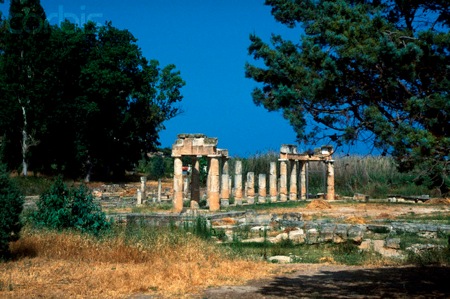
To that end I am looking through theoi.com for hints about where to start, and among the cults of this goddess that struck me was one I had heard of before but never given much thought to. It is the cult for Artemis of Brauron, the bear goddess. Now, as great as theoi.com is, it is not a research site, it is a site of quotes, like a large bibliography, allowing you to see quotes from ancient sources with regard to a particular deities, heroes, and other mythological characters.
Among these quotes are these:
Callimachus, Epigrams 35 (from A.P. 6. 347) (trans. Mair) (Greek poet C3rd B.C.) :
"Artemis, to thee Phileratis set up this image here. Do thou accept it, Lady, and keep her safe."
Suidas s.v. Lysizonos gune (trans. Suda On Line) (Byzantine Greek lexicon C10th A.D.) :
"Lysizonos gune (girdle-loosening woman) : She who has drawn near to a man. For virgins about to have sex dedicated their virginal lingerie to Artemis."
Pausanias, Description of Greece 1. 23. 7 :
"There is also a sanctuary [at Athens] of Artemis Brauronia (of Brauron); the image is the work of Praxiteles, but the goddess derives her name from the parish of Brauron. The old wooden image is in Brauron, Artemis Tauria (of Tauros) as she is called."
Herodotus, Histories 6. 138 (trans. Godley) (Greek historian C5th B.C.) :
"The Pelasgians dwelt at that time in Lemnos [C6th B.C.] and desired vengeance on the Athenians. Since they well knew the time of the Athenian festivals, they acquired fifty-oared ships and set an ambush for the Athenian women celebrating the festival of Artemis at Brauron. They seized many of the women, then sailed away with them and brought them to Lemnos to be their concubines."
Suidas s.v. Arktos e Brauroniois (trans. Suda On Line) (Byzantine Greek lexicon C10th A.D.) :
"Arktos e Brauroniois (I was a bear at the Brauronia) : Women playing the bear used to celebrate a festival for Artemis dressed in saffron robes; not older than 10 years nor less than 5; appeasing the goddess. The reason was that a wild she-bear used to come to the deme of Phlauidoi and spend time there; and she became tamed and was brought up with the humans. Some virgin was playing with her and, when the girl began acting recklessly, the she-bear was provoked and scratched the virgin; her brothers were angered by this and speared the she-bear, and because of this a pestilential sickness fell upon the Athenians. When the Athenians consulted the oracle [the god] said that there would be a release from the evils if, as blood price for the she-bear that died, they compelled their virgins to play the bear. And the Athenians decreed that no virgin might be given in marriage to a man if she hadn't previously played the bear for the goddess."
You may wonder what these quotes mean to me, but it is not so much their meaning as their attestation that I was looking for, and that last one, a description of something I always find intriguing about religious ritual, in this case, a ritual for the Goddess Artemis, and that is the re-enactment of an even from the far past. Just as many Christian cultures re-enact the birth of Christ during Christmas, or the Passion during Easter, so too do many Pagan festivals and rituals work to re-enact something of importance to the people in the past.
For reconstructionist pagans, such as Hellenistoi, there comes a small problem, the problem of disconnection. To the people of Athens who celebrated this festival in which girls, quite young, performed this "playing the bear" for Artemis had a special connection to this bear event. To them, especially to a particular tribe or deme, this event in which a bear was killed unjustly for essentially behaving like a bear, had special significance, and while we may seek to understand what it was, apply psychological reasoning to it, or seek to empathize with it, we cannot truly know what it was those people thought or why this partiucular event was of such importance to them that they commemorated it in religious ritual forever.
There is, of course, the pestilence, and the blaming of the pestilence on the unjust actions of the girl's brothers, a common thing in ancient times, and sometimes even today in our own culture, and maybe even a hint of a time when a young girl was chosen as a sacrifice to serve as a scapegoat.
The story of the bear drawing blood from the girl here symbolizes the possible sacrifice of the scapegoat, and the anger of the brothers and the taking of the life of the bear perhaps a transference of the scapegoat status to an animal rather than a human.
I think this particular myth, as with the myth of Iphigeneia, entrusts to us a history of the shift in sacrificial methods of the Hellenic people. From a time when savage human sacrifices or human scapegoating was performed to a time when an animal was used instead, and in the case of this bear, where there was a shift again from the use of a wild bear, taken in and tamed for the sake of using it as a scapegoat, to using a kind of "passion play" instead.
I see in this myth a shift in the relationship between man and the gods.
As for Artemis of the bears, it seems not at all odd to me that Artemis of the bears would send a pestilence to the people after the misuse of this bear. Not because Artemis as a deity has a problem with the killing of animals, but because maybe she has a problem with the use of a wild beast not normally used as food, though it is certainly edible, for something like this.
The girls in the saffron robes symbolize a shift in that relationship. A shift away from superstitious sacrifices to sacrifices based on the consumption of animals, allowing us to share what we eat with the Gods. But also, a shift in the ritual forms, taking them away from the savage and making them more and more an expression of our artistic imaginations.
Artemis of the bears. The aspect of Artemis that seeks to remind us to pay respect to the world around us, especially to the life that surrounds us.
I am talking here about a different kind of reaction, and to something physical, not to the Gods, although I guess I could argue that everything involves the Gods in some way. Yesterday, I awoke to a nice day, a Sunday, no work, my birds chirping happily in their cages, and everything fairly normal, the way I like it. I had to do a little cleaning, a little vacuuming, a little dish washing, but that's all a normal part of life. I did some web surfing, some TV watching, listened to some music, meditated, and did a little reading.
But something happened in the afternoon that shook me. I walked into the kitchen and noticed that something was wrong with one of my bids. A female cockatiel who'd taken on the name Missy. Normally, I don't name birds. They do not respond to names, unless they are parrots, and even then I am not sure they do, but as I went on, I found that I was always referring to these two as buddy and missy, so they became Buddy and Missy.
She was not breathing normally, and as the minutes passed, it got worse and worse until finally, I reached into the cage. I knew right away it was deadly serious because she did not try to get away. Missy was much friendlier than Buddy in that respect. If she was out and flying around, she would get on my hand, and she had no problem climbing onto my shoulder, or even my head, but normally when reaching into the cage, both she and buddy would not want picked up. This time, however, she did not move or struggle, and her breathing was a horrible loud wheezing. I tried to get her to drink some water, but she would not take any. Just minutes later I watched as the life drained out of her.
Missy is gone.
My reaction was not subtle.
I am not an emotional person. I am not prone to crying or even lots of any other emotions, but I had some kind of weird semi-crying semi angry mess. I am not sure how to explain it, but this little bird had provided me with something that is now missing, and I find myself saddened.