Wednesday, August 31, 2011

Artemis, Lady of the Mountains

Artemis is, it would seem above all other things, a Goddess of natural places and natural occurrences. The forest, the wooded mountain sides, the tidy holes animals hide in, caves, etc. But also, of moon lit nights, of growth, of hunting (a natural activity), and birth, and the dangers that come with it. She is a goddess of children and young mothers, and of the young animals who, often, require much protection in order to survive.

She is a protective goddess, but also a dangerous goddess, because in her pervue is also the death of birthing mothers, or the children they birth. Often seen as a horrible thing, one can also see these as a mercy, though to the families involved it will never seem that way. As a "nature goddess" I have much to be thankful to Artemis for. The beauty of the world and the shifting changes that are its most enduring characteristic, are something we all need be grateful for, even if it also means our aging, our disease, and our deaths.

But therein lies a problem for me, because I am very much a city man, and like most of us, I am rather disconnected to nature and her many many cycles. Yes, I am affected by time, by disease, by the changing seasons, but the effects I perceive in my life seem to be the grander shifts in natures moods. The weather, the sunrise, the seasons. But Artemis is also present in many of the other, smaller shifts in our day to day reality, which we who live in the cities, often neglect or never become truly aware of.

If I am understanding what I am feeling with regard to Artemis as I write this, then I must force myself to move beyond the metaphorical city walls. To allow myself to be exposed to natures smaller miracles so that I can come to, if not an understanding, than an experience of what it means to me as a living piece of nature. The goddess Artemis, Lady of the Mountains, is not the mountain, not the leaves on the trees, not the beasts that move among them, but she is there in the threat of predation, in the changes and little shifts that decide our fate, live or die, survive or fall prey. She is part of that instinctive fear that keeps us alive, but also the fearlessness that allows us to confront our prey, metaphorical or not, and come out the victors. 

Now, how do I embrace this? How do I plunge headlong into an experience of her and her power?

Monday, August 15, 2011

Artemis

I move to a goddess who I actually have very little experience with. In my personal worship, she is usually linked to my morning candle lighting ritual, tied to the other two virgin goddesses of Olympus on my altar and invoked in this aspect. An aspect of protection, or purity, and of strength. Along with Athena she forms a kind of Virgin Trinity, though not in the Christian sense. She is here not so much Artemis the Great Olympian Goddess, but Artemis the spirit of youthful energy and divine movement, something I also tend to associate with Athena in this aspect of protective purity.


But anyone who has made even a cursory review of Artemis as a figure in ancient Greek religion knows that simplifying Artemis is not an easy thing to do, that she is, in fact, one of the most complex figures in the Greek pantheon of Gods. Seen by the ancients in a vast variety of ways, she was virgin huntress, moon goddess, protector of birthing mothers, sometimes killer of same, and with her brother Apollo, was associated with both healing and disease, though not to the same extent as he was. But across the Aegean, in the Eastern Greek world, she was also worshipped in ways one might find peculiar to a goddess so well known for her youthful virginity. She was a "Great Mother" type goddess, though we have to try and remember that this particular paradigm has been partially discredited. From little girl sitting at her father's knee to the goddess to whom blood was let by youths in Sparta. The breadth of her worship is one that can be daunting, and among the ancients it was not all encompassing, as it is not among those of us who believe in her existence today.


As with all the Gods, Artemis' many aspects do not actually have to be reconciled one with the other, but they must be reconciled with the worshipper if he or she is to properly give her honor and worship. As a worshipper, I must worship and accept the aspects of the Goddess that make sense to me, and I have to find which of those aspects seem to contradict my personal gnosis. When they do, I must either find a way to make them make sense, or relegate them to the cults of others. I found a long time ago that it is not necessary to worship the Gods in every aspect. It is only necessary to worship them in those aspects that touch me, to give thanks for those and if I feel I need, to call on those I need in my life.


With Artemis, it is a difficult road to take for me. I am no virgin. Boy am I not a virgin. I am no hunter, though I do not oppose hunting for food. I am not a healer, or a woman, or likely to ever give birth. I call on her for her protective power, and because part of me wants to protect what is left of my inner child so that I do not let myself get old and crotchety (some will argue it's too late for that) but I do not have many of the qualities in me for which ancient people often gave thanks to her. But these meditations I seek to make on the nature of the Gods and how they affect me are meant to help me to understand them and how they fit into my life better, and to explore and find those aspects of me that I have, perhaps, not allowed to come to the surface.


So, blessed Artemis, I am opening myself to you. Come! Show me! Teach me!


Thursday, August 11, 2011

And so, I move on...

With a lesson learned, but not implemented, I move on from Hephaestos and onto the next point in my meditation star.


It leads me now to Artemis, lady of the wilds, goddess of the hunt, goddess of the crescent moon, and great virgin goddess. Artemis may turn out to be a hard one for me. I am not a girl, I do not hunt, and while I have great respect for her, I have eschewed many of the human activities, like hunting and child rearing, that she is said to patronize. But there are aspects of this goddess that straddle a very important line in our myths, and it is one I hope to explore. What is that line? In due time...

Monday, July 11, 2011

But, one more thing about Hephaestus...

Hephaestos' myths include a conflicting relationship with his parents. Myth tells us that Zeus and Hera were so disgusted by the imperfection of Hephaestos that they threw him from Olympus.

Crashing down upon the Earth he was saved by Thetis, and in her care and that of Eurynome, he was hidden in a cave surrounded by Ocean (An Island) where he learned to work metal and stone to create magnificent pieces of art and practical utility.

The myths vary, of course, all myths do, and in some cases he is the son of Zeus and Hera and in others the son of Hera alone, who bore him in anger against Zeus. But regardless, it left him with, if not a hatred, a disdain for the actions of his mother.

I can relate to this, though in my case, it is the actions of my father that I associate with this spirit of abandonment and rejection.

I know, I am old enough to be over this, and in most aspects of my life, I am, but in others, I know the disdain I feel for my father informs a great deal of what I feel toward my family as a whole.

My mother is not at all pure and innocent, she was abusive as well, but his abuse, his lack of concern for us, and his abandonment of us combined drove a steak in my heart that I find hard to let go of. I can't love him, even when I try to be civil, I just can't love him, and I think, perhaps, the reason I am having trouble moving on from Hephaestos is that he wants me to let go of this. I think, maybe, he wants me to reconcile with my father, even if I can't love him.

It's not something I can manage any time soon, and so I am going to have to work on my inner self, my thought processes, in order to get myself to a place where I can do that.


Thursday, July 7, 2011

I Am War

I go out for you

To the slaughter and the suffering of the battlefield

Where you ask me to kill or be killed

To murder and rape and pillage in your name

I am forgotten, displaced, and mistreated on my return


I have feinted in the heat of the day

Born down to the earth by the weight of this armor

The blood pouring from parts of me I can no longer feel

The fear and release of exhaustion reminding me I live

The shit on my legs no longer bothering me


I have killed children

In the torching of cities, they have died

I have watched as mothers hold strong to their children as arrows pierce their hearts

My heart aching to see my own children who have likely forgotten me

My adored wife a distant memory, her face no longer clear in my head


I have suffered for you

And at my return I see your scorn

I see in your eyes the distaste for what I have done

I see in your face the distaste for what was asked of me

I see in your posture the loathing of the reminder that it was you who asked it of me.


I am war, your companion

I am war, your protector

I am war, your enslaver

I am war, who you hate

I am war, without whom you do not thrive.

Sunday, June 26, 2011

Taking stock...

So, I have been at this point in the star for some time, and part of me wants to move on, but, I still am not sure I get it. Yes, Hephaestus has shown me things about me, things about how I react to stresses, ideas, and to the environment that surrounds me. Hephaestus has given me a different, though not pleasant, perspective on work, and he has given me a glimpse into the fiery depths of his being.


But in forcing me to essentially take stock of myself, I have also been forced to take stock in them, the Gods, and what it is I need from them, want from them, can expect from them, and how all of these actually manifest in my reality.


For one thing, Hephaestus has shown me, I think, more clearly than ever, that the Gods are not manifest solely in a single place and in a single form. The Gods manifest throughout the world and throughout history in a great many ways. We know this. We see it in the mythos of the Greeks as surely as we do in that of the Romans, Hindus, Chinese, Japanese, and even the Christians. The divine sphere does not make for an easy and simple translation, ever.


But to me, it means that Hephaestus has shown me that it is OK to see him in a God of the Hindus if a Hindu meditation is what I need to quiet my mind. That it is OK to see him in a Chinese form if the prayers of an ancient Chinese philosopher seem apropos to my dilemmas today.


Not that I am becoming eclectic or anything, mind you, I still believe, and I think Hephaestus has helped me to deepen this belief, that the context of a mythic and religious system is at least as important as the myths and philosophies themselves.


That I am more willing to listen to and be enlightened by Hindu or Buddhist philosophy today than I might have been five years ago is, I think, something Hephaestus has guided me to and helped me to realize in my life. That I am more willing to listen, to hear, and to digest that which another has felt and made manifest in his own life is something he has guided me too as well. But also, how to be strong within my own convictions even as I continue to evolve.


That is to say,  to keep the fires of the forge burning, and the embers steady, even as I busy myself forging the iron that is my soul into a new and more pleasing form.

Tuesday, June 21, 2011

My New Babies

My new budgerigar. Haven't named her yet. She's a bit quiet, and I think she needs a friend, but that will have to wait a few weeks. She's very bright of color, so I am thinking of calling her Venus.


My new Cocatiel. She is a bit aged, but healthy, and is a bit on the quiet side. She still has no name, but I am thinking Juno.

And here's the male, noisy little bugger, younger, and cheerful. This little bugger actually sings. I don't mean he sings like birds do, you know, calls in the morning, chirps. I mean he sings, like listening to a person hum. Sometimes I put on music, which they all seem to like as I sometimes catch them swaying to it, but he sometimes starts to sing. Not along with the actual tune of the song, mind you, but it does sounds sometimes like he's trying to mimic it. It is the cutest thing.

I think he will be Jove, but I have not really decided yet, because his singing makes me think Phoebus or something like that. Still, if he is in the cage with Juno, he should be Jove, no?

Monday, June 13, 2011

They Love Each Other

True to his own heart

True to her own desires

True to their own feelings


They love each other

Aphrodite binds them

Hera sanctifies them


True to her own emotions

True to her own needs

True to their own passion


They love each other

Aphrodite draws them together

Hera hallows their union


True to his own lusts

True to his own longings

True to their own honor


They love each other

Aphrodite ensorcels them

Hera makes consecrates them


Monday, June 6, 2011

Athens

Athens is, perhaps, the one city everyone thinks of when they think of ancient Greece. To a Greek, this is not necessarily so, as they are aware of the vast richness of ancient Greek architecture, art, and literature that originated in many places all over the land we call Greece. To those of us who are not Greek, however, Athens is the shining glory that was ancient Greece.


It is in ancient Athens that we see the ideals come to flowering that we hold dear in the West. It is in Athens that we see the flowering of philosophy, democracy, and the ideal of equality. Oh, we are not blind, of course, we know that women, slaves, and non-Athenian born free men did not have the same rights as the citizens, and that Athens had a strong and powerful aristocratic class that often made a mockery of the democratic process, but the truth is that we recognize in that society something very much a kin to our own.


When the United States were founded, it was with an ideal that would need centuries to come to a greater flowering. The founders of our nation saw in Athens and the systems they set up as ideal, and they sought to write into our constitution a system that would grow and change while retaining that unique characteristic we call democracy. That they needed to use the Republican system to make it workable is understandable. Like Rome, the United States would prove too large, even in colonial times, to rule with a truly democratic system, but where the Athenians had lead the way, and the Romans had tried to follow, America wanted to continue.

Like Athens, we had an imperfect system. We had women who could not bring their voices to bear on government, slaves who were counted, but only as cattle might be, and other people who, while free, were not to be given the same rights as the citizen class. A class which, at first, was very aristocratic in nature. The founding of our nation was, in almost all ways, a reflection of the Athenians who had lit the light of democracy so long ago.


For many of us who worship the Gods of Olympus, it is ideals such as democracy and liberty, the love of art and architecture, the desire to know as embodied in the Greek arts of philosophy and science, that drew us. We were drawn to the Gods who had presided over the birth of these ideals, and would seek to worship them again in an effort to once again allow their influence into the world.


The glory that was Athens, with its art, its architecture, its science and philosophy would call to us and lead us to the very Gods who once fought over her land so as to claim it. The same Gods who would inspire them to achieve, in sometimes miraculously short amounts of time, such incredible things that to this day man kind has not met their challenge.


We who wish to see the influence of the Gods once more alive in the world, however, must not allow ourselves to be stopped from bringing it to light. We must not allow our conflicts, and the influences of the Abrahamic faiths and nationalistic endeavors to stop us from embracing the truth. The truth that the Gods live, and in large portions of the world, man has become blind to their presence. That the Christian and Moslem faiths, with their hate promoting zealotry must not be allowed to kill off the power that lies in the realization that the Gods, in all their names, in all their glory, can lead us to live in peace while embracing our diversity, not by destroying it.


That as the Athenians learned to build a system that gave a greater voice to its citizens, flawed system though it was, we can learn to create a system that will give the Gods a voice in the world that will bless us all with that same spirit of freedom and liberty we have often aspired to in our nation. A system in which all men and women, no matter their race, their religion, their sexual orientations can have a voice that sings in pride to the blessed Gods who dwell in splendor.


Monday, May 30, 2011

These are Yours

The clamor of battle

The clang of steel

The smell of smoke

These are your companions

The cries for help

The orders of generals

The loss of friends

These walk with you

The man before you

The woman behind you

The phalanx around you

These are your protection

The lost spirit within

The heartache and pain

The memories you will never forget

These are your trophies

The Lady of Wisdom

The Lord of the Battlefields

The Lady Liberty

These are your Gods, may they never desert you!

Sunday, May 29, 2011

Recommended Reading

Recommended Reading: By Being, It Is by Nestor-Luis Cordero. Haven't read it yet, but got many recommendations.


The Herm

To the West I made a place for you.

A stone pillar, polished and neat.

With the shadows cast by the setting sun.


It marks the border.

It marks the end.

It marks the point where day says farewell.


To the North I made a place for you.

A stone pillar, old and weathered.

With the snows of Winter and the growth of Spring.


It marks the border.

It marks the end.

It marks the point where Spring gives way to Winter.


To the South I made a place for you.

A stone pillar, brightly painted and in ribbons covered.

With the heat of Summer and the sounds of the sea.


It marks the border.

It marks the end.

It marks the point where Summer is King and Winter unknown.


To the East I made a place for you.

A stone pillar, golden and clean.

With the songs of man seeking you.


It marks the border.

It marks the end.

It marks the point where the Sun greets the world and sacred land begins.


At the borders of my mind, I leave a place for you.

A stone pillar, like a phallus shaped.

With vines and ivy slowly claiming it.


It marks the border.

It marks the end.

It marks the line that none may cross.


Friday, May 27, 2011

Having cooled down

Hvaving cooled down some, I have come to realize two mistakes I have made. One, I neglected how general a phrase like "Greece is full of..." comes off in English. So, people have been right to point out that I have been accusing the Greek people themselves of being racists.

This is, of course, not true. I know this for a fact, having known and interacted with many Greek people during my life. What I should have said is that there appears to be a movement in Greece of people who seem to believe that the Greek people are of pure genetic stock and are superior to all other people. There are people here in the US who think the same, and in France, and in Argentina, and in China, etc. So, it was unfair of me to use so general a phrase, even if I did it unintentionally, because I should know to reread the things I write when I am feeling angered by others.

My second mistake, technically the first but I realized it second, was in engaging these kinds of people in an argument in the first place. Like religious zealots, racists and nationalists tend to adhere to their line of thought or belief with no chance of being argued out of it by anyone, especially anyone as limited as myself.

I should have just known better than to try to argue with them.

Now, this doesn't mean that I have changed my mind about anything that I said with regard to these people. They are an insidious cancer that has to be fought. I know that a lot of us "pagans" like to be incredibly accepting. That whole "let everyone believe whatever they want" thing does not sit well with me if the belief in question includes spreading a racist agenda.

I am not talking about supporting laws that restrict speech or anything like that, as I am a strong believer in free speech, free press, free expression, but in establishing groups and online communities that support and spread a more universal system for Hellenism.

So, Universal Hellenismos, the acceptance that the Gods are not meant for any one people, but can be, and seek to be found by all people. To some appearing this way, to some that way. That the Gods do not want us at war with each other over religious dogma, but for truly just reasons. That the Gods seek to help us become wiser beings, not their slaves. That all human beings are equal in their eyes and that it is the things we do and how we treat each other that matters in the end. That among the many things humanity should strive for, hospitality toward one another, love of family, protection of the defenseless, and above all others, the wisdom to act with justice always in mind, should be the most important and the ones that our religion promotes.

These are the ideals we must strive for. Because while live and let live can be a good thing, turning a blind eye to injustice is not.

Tuesday, May 24, 2011

Opening my eyes...

My eyes are being opened to something I have blinded myself to for a long time. A recent experience on Facebook has forced me to take a good look at what I have been doing religiously, and why I have been going about it wrong.

A simple discussion on a Facebook board which started with the question "Is Macedonia Hellenic or not?" ended up with me being yelled at about the purity of Greek blood and how my being American was why I did not understand things. Accusations that I have Arab blood, which I do, and African blood, which I do, spewed forth as if either of these were something to be ashamed of while outright denials of the clear fact that Greeks themselves have a great deal of Slavic and Turkish blood in their lineage led me to realize that Greece, today, is full of racists and nationalists who are attempting to adhere to the same "religion" I am.

I have to admit that for a second there I was ashamed of this "religion", that I thought I must leave this path in my life in order to distance myself from that kind of ridiculous stance.

I have, I think, forgotten that the Gods are not Greeks. The Gods are The Gods, and how we see them is often times more a reflection of our own issues than theirs. That the Olympian Gods don't care if I am a mutt, and perhaps, just perhaps, the Gods have chosen to touch people in many different parts of the world in an effort to force us to look back at the land we call Greece and, perhaps, force them to stop the insanity.

I am not talking about proselytizing, I am talking about being more assertive. That those of us who pray and worship at the altars of the Gods without the nationalist overtones, without the sad claims to racial purity, without all the bullshit, to be quite honest, should become the voices of reason, and rather than just sit back and be all "Let people do what they will" we should be a little more "No, racism and nationalist agendas are not Hellenismos".

We should not allow ourselves to defer to the Greeks just because they are Greek, that is in itself a form of racism, but speak out against such things in the name of the Gods, because the Gods are not racist nationalists, they are the Gods, and they have touched people throughout the world, in many ways, by many names, and have never sought to destroy a people for being different. Man has done these things.

Sorry if I sound a bit angry, but I am seldom touched by racism anymore, as I have always been fairly capable of speaking my mind on that particular issue, or not caring what others think of me, but this, this hit me harder than I thought it would, and now I have a lot of thinking to do.

My current guide along the star, Hephaestos, seems to be throwing me into something new here, new for me, and perhaps, forging me into something new, something a little more active in this "community" of ours so that we can stand up to people who, in the name of the Gods, will do wrong.

Can I get an amen?  :)

Published with Blogger-droid v1.6.9

Wednesday, May 18, 2011

Concepts

Conveying a concept is not an easy thing. Look at the number of people you meet every day who can't seem to finish a thought, much less convey the mental structures, the concepts, in their heads.

I admit to being one of those people.

I have a hard time saying what I want to say without straying back and forth. Basically, it works like this, I start to write out a particular thought and as I do so, 50 others happen and I become derailed.

Some people call it a form of ADD, I refer to it as a lack of focus, and focus is something that can be learned.

So, what is this about concepts I want to get to?

The concept is "god"

Right now, though, I have to get to work, so I will have to tackle it later.


Tuesday, May 10, 2011

Homeric Hymn 20 - To Hephaestos

"Sing, clear-voiced Mousa, of Hephaistos famed for inventions (klytometis). With bright-eyed Athene he taught men glorious crafts throughout the world,--men who before used to dwell in caves in the mountains like wild beasts. But now that they have learned crafts through Hephaistos the famed worker (klytotekhnes), easily they live a peaceful life in their own houses the whole year round. Be gracious, Hephaistos, and grant me success and prosperity!"


Thursday, May 5, 2011

Purification of my soul

I believe in the soul as a manifestation of our psyche, not as an eternal and ephemeral force. I am not a luminous being, as Toss might put it, but a physical being who glows with the light of sapience.
There is nothing magical about it.

But we live a good number of years, we physical beings, and during that time, it would be a shame not to seek to grow our minds beyond the confines of our physical needs to the glorious speculation and wisdom that comes with knowledge.

But more than that, it is important to learn how to gauge our own intent. How to make our will and intention pure. For these things we turn to the Gods.

The Gods are not physical beings like we are. They are physical in the sense that they exist as part of the greater structure of the universe, just as we are part of our small part of the cosmos, but there is to divinity a purity that comes from intent and action and how the two are not about what they need or want, but about what is for the best of all things.

That is the kind of purity I am looming for. To let go of selfishness and embrace the betterment of us all.
Published with Blogger-droid v1.6.8

Monday, May 2, 2011

Dead

t1larg.bin.laden.gi.jpg

Thank the Gods he is dead!

If there is any truth to the myth of Tartarus, may he be deep in its bowels, being torn apart by titanic beings hungry for flesh for eternity.

Sunday, May 1, 2011

Purification

Fire has many manifestations in human spirituality. As in the more realist paradigm, so in the spiritual one, and fire is destructive, cleansing, purifying, and even creative. As I have tried to manifest Hephaestos in my life, which I admit has not been easy, I have started sharing certain aspects of my life on Tumblr, aspects not directly related to Hellenismos, and hence why I have not cross posted them here, but it occurs to me that this decision was indeed part of my manifestation of Hephaestos.

Hephaestos not as creator, not as destroyer, but as purifier.

Deciding to share these things, even if no one is actually reading them, has always been part of how I deal with my inner turmoil, my inner pain, my inner self destructive impulses. Letting things go, verbally or as written text helps me deal with them and process them, and this blog, as well as that one, has given me a means to let go of a lot of inner conflict. Inner conflict that pollutes my soul.

Of all the Gods, I never quite thought of Hephaestos as a God of purification. Apollo? Absolutely. Hestia? Of course. But, Hephaestos?

It wasn't until I started to realize how limited my view of the Gods can be that I started to open up to ideas that allowed the various Gods to manifest in my life in unexpected ways. They may even have been manifesting that way all along, and I simply refused to see it. When you start to look at the way particular Gods are worshipped all over their respective worlds, in our case Greece, you start to see how immensely diverse the influence of the Gods can be. It is amazing to see the way Aphrodite seemed to the people of Cyprus, for example, versus the commonly viewed imagery and mythology that was so common among the people of the pan-Hellenic world. And when you look at the Hephaestos of the Athenians versus the Hephaestos who is father of the Kabeiroi, you start to feel foolish in not having allowed yourself to see him before then.

When I speak of Hephaestos as a God of Fire I do not speak of it in a magical way. I am not a follower of magical traditions, but that he is, in fact, a God who manifests through the use of fire. He is not the flames, of course, those are part of the chemical reactions that are fire, but there is to fire something that symbolizes his power to us, and part of that is how he manifests as a purifier of the soul through physical labor and our meditation on its impact on us.

But also, just as fire can allow for new forest to grow, clearing out old brush so that new seedlings can take root, so too can the fires of Hephaestos allow us to clear out our fears, doubts, and self destruction if we are willing to accept how he manifests in our psyches. That unlike Hestia, who manifests as protection and warmth, or Apollo, who manifests as the light that illuminates the darkness, Hephaestos manifests as the fire in which we must forge ourselves anew. He requires us to work and sweat to achieve the purification he has to offer, and I wonder if I have what it takes to do that kind of work.

He pushes me, but I find myself pushing back, and now I have to figure out why I would do that...

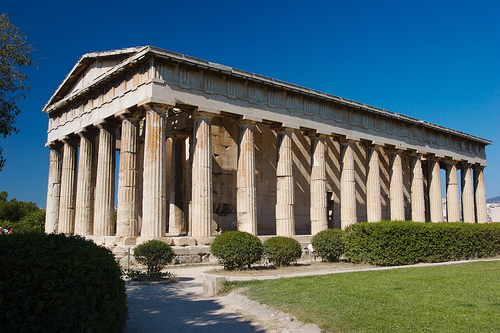
Temple_of_Hephaestus.jpg


Tuesday, April 26, 2011

Spring rededication

It occurs to me that I have never spoken about my annual rededication of my central altar (Actually, it happens more than once a year, but I always have one in the Spring) which I call, or used to call, my Altar of the Virgin Goddesses.

This altar is dedicated to Hestia, and upon it are images of Athena and Artemis as well, but this year I decided to make a change. While the altar remains dedicated to Hestia, I have added an image of the Minoan Snake Goddess (I know that the image itself is controversial as far as scholarship is concerned, but the imagery and symbolism of it do not go amiss in Hellenism) which, for me at least, are representations of the divine Mother Earth, who we call Gaea.

Many cults of goddesses, and some of Gods as well, have imagery that uses serpents as representations of the Earth and its regenerative power, but also of its chthonic and divinatory nature. The Pythia's title itself is related to the divinatory nature of her office, and the serpent, an aspect of the Earth, which once ruled Delphi.

So I bought this image of the snake goddess, which to me represents the chthonic, or Earthly, aspects of the divine Goddesses we worship, and especially of Gaea herself, the Great Mother. This morning I received the statuette and went about dismantling my altar, removing all decoration and dedications, cleaning them, and then rebuilding it with the addition of the new Snake Goddess.

Below are images of what I did in a lovely little slideshow.

After cleaning the objects and statuettes and replacing them in the fireplace, I relit the candle and lit some incense, offering a prayer to the gods, and especially to Hestia, that the altar may be accepted and pleasing to her.


Wednesday, April 13, 2011

Beautiful Temple of Minerva

Minerva Shrine at Sbeitla

This beautiful ruin of a Roman temple to Minerva, who the Romans equated with Athena, is an example of the kind of temple I would love to build. Simple, yet dramatic, it would make me proud, this temple. I would create four chambers inside, each with a statue of Athena in a different aspect. The First, to Athena Parthenos, the second to Athena Xenia, and the third to Athena Soteira. The final chamber, accessible from the back, would be either for storage of temple goods, or a home for the attendant of the temple. Maybe my dream of building this will come true some day, the Gods willing.

Declan McCullagh has a site with pictures of this site, the picture above is not from his site.

And this, at Trek Earth, great site, by the way.

Sunday, April 10, 2011

But am I learning anything?

While I am learning a thing or two, I am having a hard time putting what I am learning into practice. Hephaestos is not a god whose influence I feel every day in my life, at least not in the way we Hellenistoi normally see him. But there is one aspect of him, as he is revealed to us in Myth, that strikes a chord in me.

He is described in myth as ugly.

I am rather an ugly looking man, and my own perception of this has, over the years of my life, caused me to be a bit self destructive. I over eat, I do not take care of myself as I should, etc. One thing I have never done, is drugs, though, and I think part of the reason is that I latched on to my ugliness almost like a badge of honor. Yes, part of me has always been very self destructive, but another has held himself separate from the norms, been unique, been different from the hordes of capitulating trend sucking fools that always seemed to surround me. I guess I used it as a way to prevent myself from conforming too much to the norms around me.

But there is something I have never quite gotten over. And that is the idea that my ugliness is actually all in my own head, because people chastise me for claiming I am ugly. Not that they ever say I am Brad Pitt or anything, but they don't believe I have the kinds of looks I do.

Yet, part of me cannot get over it, I do not see it. I see ugliness, and strive to make up for it in other ways, and as I embarked on a plan to lose weigh a couple of weeks ago (15 pounds now, yay!) I have to consider why I feel the way I do about myself in relation to my search for inner peace and acceptance. And in relation to the divine, who we all think of as beautiful, a prejudice that is part of our own human conceptions of the world, because divine beauty is not physical, it derives from the way we perceive their state of being, a state of being that is not decaying, not moving toward death, not subject to the same horrors we are.

Hephaestos, though, was perceived as ugly. Ugly because he wasn't perfect, yet the creator of so much beauty that the gods had no choice but to accept the divine nature of his power. How do I deal with my own perceived ugliness? How do I accept it and move on?

Tuesday, March 22, 2011

I walk with you...

I walk with you, Lady of Love, though I do not have love in my life.
For you offer to me hope.


I walk with you, Lady of the Corn, though I do not till the land.
For you offer me sustenance.


I walk with you, Lady of Marriage, though I cannot marry. 
For you offer me a dream.


I will walk with you, Aphrodite, in the passions of my nights.
For I love the feel of your touch.


I will walk with you, Demeter, in the kneading of my bread.
For I will delight in partaking of it.


I will walk with you, Hera, in the bonds I form day to day.
For I dream of a day, though it may never come, when love, domesticity, and the marital bond is mine.


Monday, March 21, 2011

The Flames of Passion

It is odd to think of Hephaestos as a god of sexuality, sensuality, or eroticism, but among the most famous of myths regarding Hephaestos is the myth of his marriage to the glorious Aphrodite. But I think there is a difference in Hephaestos' role here than that of say Ares or Hermes, both of which are like paragons of male sexuality. They are represented in myth and art as beauteous, strong, lovers that likely can take you to the edge of orgasm by just looking at them, but in Hephaestos there is something else.

Hephaestos is a lame God, he is described in myth as a limping almost troll like figure. In Northern traditions, Dwarves are much like the description of Hephaestos, even down to their renowned industriousness and gift with metalwork. But Dwarves, for all their skill, are not attractive creatures to human beings.

So why would I think that the myth of Aphrodite and Hephaestos is one of sex, rather than the more commonly held notion that it is about Aphrodite's infidelity.

Aphrodite's infidelity, you see, is not a story about infidelity. Surely, that is part of it, but it is actually a story about the inability of man to imprison a woman's heart to a man she does not love. It is not that Hephaestos was not man enough for Aphrodite, by any standard of ancient times, Hephaestos would have been a hugely wealthy man, and he would have provided her with all the things she would have ever needed, except she did not love him. He was forced on her, and in this, this myth is a criticism on the ancient notion that a woman is property with no ability to choose her own husband, even if it is not a husband daddy approves of.

Hephaestus net Martin Van Heemskerk 1536

But from Hephaestos' side of the story, it is a cautionary tale. A tale about not being lead by your cock, because let's face it, the cock wants the prettiest, sexiest, and hottest. It has no notion of love and reciprocity in relationships, it only wants to feel really good while doing what it was designed to do. And be you gay, straight, or bi, the cock thinks the same way, it wants to fuck, and it wants the hottest person, or people, to do it with, and Hephaestos falls victim to his cock and demands the most luscious, beautiful, and sexually alluring of all creatures, and pays the price for letting his desire for that beauty outweigh his ability to think about the future.

Hephaestos, in association with sexuality, is a god who cautions you to beware. To not always be lead by your cock, but to think through the emotional price of allowing that to happen. Being horny is not a problem, Aphrodite's gifts are beautiful, but when you are needful of emotional connection, of love, and of that someone, or those someones, who can give you more than a good feeling down below. Aphrodite, goddess of love can gift you with that as well, but you must heed the warnings and think so that you not be trapped into the same horror that Hephaestos went through in his most famous myth.

I guess, as a sex god, Hephaestos is teaching you to stop, look, and listen, and when you find the right one, go for it.